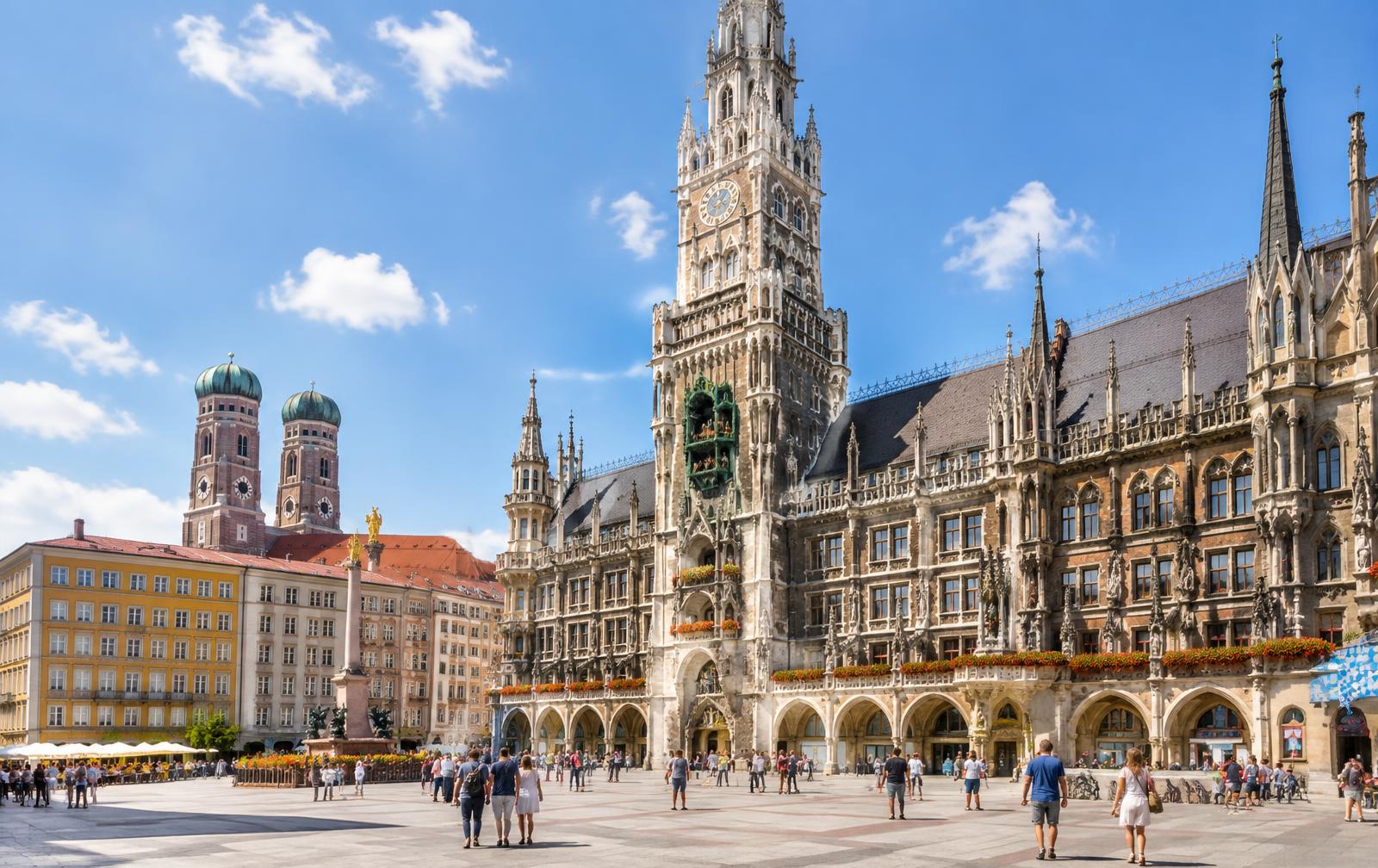
Skyline and streets of Munich, Germany

Munich

Germany

Back to All Destinations

Overview

First impressions

Munich is Germany's most livable big city, and it feels that way the moment you arrive — wide, walkable streets, English spoken almost everywhere, and a genuine beer garden culture that has nothing to do with Oktoberfest tourist buses (though those exist too, if that's what you're here for). It's more relaxed than Berlin and more traditional than Frankfurt, with a compact historic center you can walk in a day and excellent public transit for everything else, including day trips to Neuschwanstein Castle and the Bavarian Alps.

Three days covers Munich itself comfortably; add a day or two if you want to get out to the countryside, which — for a city trip — is unusually easy to do here.

History & Stay

  • A brief history: Layered with centuries of history, Munich carries the marks of every era of Germany, from its founding through modern reinvention.
  • Recommended stay: Three days covers Munich itself comfortably; add a day or two if you want to get out to the countryside.

Quick Facts

Everything at a glance

Language
German (English widely spoken, especially with younger locals and in central areas)
Currency
Euro (€)
Visa
US citizens: visa-free for up to 90 days in any 180-day period (Schengen Area). ETIAS pre-authorization is expected in late 2026 — check etias.com or travel.state.gov before you travel
Power plugs
Type F ("Schuko," round pins with grounding clips; Type C also fits) — 230V/50Hz. Most modern electronics need only a plug adapter
Main airport
Munich Airport (MUC), about 28km from the city center. S-Bahn lines S1 and S8 run directly to Munich Hauptbahnhof (main station) in 40–45 minutes; a Lufthansa Express Bus is also available
Climate
Cold winters (20s–30s°F), warm summers (70s°F), noticeably cooler and wetter than southern Europe
Best time to visit
Spring (March–May) for the best balance of mild weather and thinner crowds. Summer (June–August) is peak season and beer garden weather, but busiest and priciest. Oktoberfest (mid/late September into early October) spikes demand hard — book well over a year ahead if that's the goal. Winter is quiet and cold except a bump around the Christmas markets in December

Location

On the map

Munich sits in Bavaria, southern Germany, on the Isar river, within easy reach of the Bavarian Alps and the Austrian border.

Budget

What a day actually costs

Backpacker
  • Accommodation
    Hostel beds (~$70–100/day all in).
  • Food
    Self-catering from a supermarket (Rewe, Edeka) keeps costs manageable. Munich's beer gardens are actually budget-friendly if you bring your own food, which is a long-standing local tradition, not a loophole.
  • Transport
    Single MVV tickets or a day pass.
Mid-range
  • Accommodation
    Accommodation runs around $100 (~$175–195/day all in).
  • Food
    Food (a mix of beer hall meals and cafés) around $50–55.
  • Transport
    Around $20–25/day if you're not using a multi-day pass.
Luxury
  • Accommodation
    Upscale hotels in the center ($300–450+/day all in).
  • Food
    Dining at Munich's better restaurants.
  • Transport
    Taxis instead of the S-Bahn/U-Bahn — Munich's luxury tier is more reasonable than Paris or Geneva's.

Note: if your trip lands during Oktoberfest, expect accommodation prices specifically to jump well above these ranges — budget separately for that window.

Things to Do

What earned its place

The central square is Munich's obvious starting point, and the New Town Hall's Glockenspiel performance (11am and noon daily, plus 5pm in summer) is touristy but genuinely worth timing your visit around once.

Bigger than Central Park and home to one of Munich's stranger, better sights: surfers riding a standing wave on the Eisbach river, right in the middle of the park. Bring a book and a blanket and spend a few hours the way Munich locals actually do.

A permanent open-air food market a few blocks from Marienplatz, good for a cheap, real lunch (try a Weisswurst with a pretzel) instead of a tourist-priced restaurant near the main square.

Less crowded than the city-center sights and an easy tram ride out, with formal gardens that are free to walk even if you skip the paid palace interior tour.

The castle that (unofficially) inspired Disney's version is about two hours away by train plus bus, and it's the single most worthwhile day trip from Munich if you have the extra day to spare — book the castle tour slot in advance, it does sell out.

Transit Tips

Getting around

Munich's MVV network — U-Bahn (subway), S-Bahn (suburban rail, including the airport lines), trams, and buses — covers the whole city and surrounding region on one ticketing system.

  • MVV tickets

    A single or day ticket covers everything within your chosen zone, and unlike some cities, Munich doesn't offer a free visitor pass, so budget a small daily transit cost.

  • Walking

    The historic center is compact enough to walk once you're there — you'll mostly use the S-Bahn/U-Bahn for the airport, Nymphenburg, or reaching the Englischer Garten's far end.

Plan & Book

Munich attractions & hotels map

Compare hotels against the attractions above and book directly from the map.