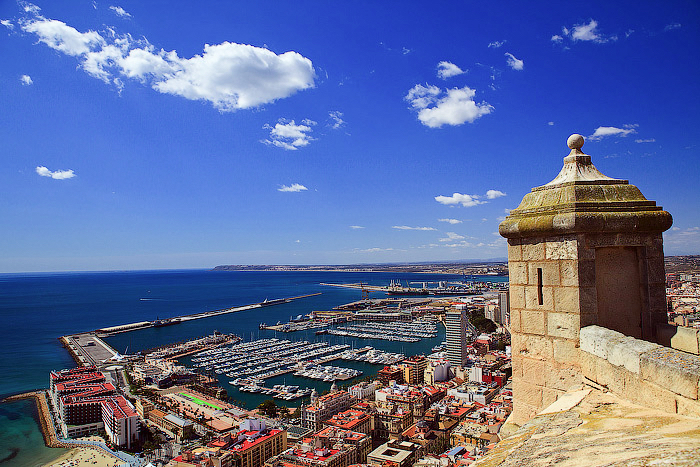
Skyline and streets of Alicante, Spain

Alicante

Spain

Back to All Destinations

Overview

First impressions

Alicante doesn't try as hard as Barcelona or Valencia, and that's part of its appeal — it's a genuine working port city with a laid-back, sun-bleached feel that the rest of the Costa Blanca resort towns nearby don't quite capture. The Castle of Santa Bárbara dominates the skyline from Mount Benacantil, and getting up there — either via the free elevator carved through the rock from Postiguet Beach or on foot up a steep zigzagging path — gives you a full view of the city fanning out below and the Mediterranean stretching to the horizon. It's one of the largest medieval fortresses in Spain and free to explore once you're up top.

Down at sea level, the Explanada de España is the city's signature promenade — a wave-patterned marble walkway lined with palm trees, running along the marina, filled with street performers, ice cream stands, and locals doing their evening paseo. Postiguet Beach sits right beside the old town, meaning you can genuinely swim in the morning and be exploring Gothic churches by early afternoon, which is a rare convenience even by Spanish coastal-city standards. The old quarter, El Barrio, climbs the base of the castle hill in a tangle of brightly painted houses and narrow streets that fill up with bars and terraces at night.

Alicante is also a smart base for day trips — the tram runs up the coast to Benidorm and Denia, and inland towns like Guadalest are an easy half-day trip if you want mountain views and a change of pace. But honestly, I found myself content just staying put: eating rice dishes (arroz a banda, the local cousin of paella made with fish stock rather than saffron-heavy broth) by the marina, and watching the sun go down from the castle walls.


Alicante sits in Spain and rewards travelers who slow down: a hilltop castle, a palm-lined seafront, and the easy pace of the costa blanca. It's compact enough to explore on foot and layered enough that two days is a real minimum.

Alicante sits on Spain's southeast Costa Blanca coast, built around the base of Mount Benacantil, with the old town and marina hugging the shoreline below the castle. The easiest way in is by air to the nearest hub (see the Quick Facts panel), followed by a short transfer to the historic core. Once you're here, walking and rideshare cover almost everything on this list.

What I love here is the everyday rhythm — coffee in the morning, one landmark or museum before lunch, a slow afternoon in a neighborhood, and a proper dinner. Every attraction below earns its place; skip anything that doesn't fit your pace.

History & Stay

  • A brief history: Layered with centuries of history, Alicante carries the marks of every era of Spain, from its founding through modern reinvention.
  • Recommended stay: 3 to 4 days to cover the highlights without rushing.

Quick Facts

Everything at a glance

Language
Spanish and Valencian (English common in tourist zones)
Currency
Euro (EUR)
Religion
Predominantly Catholic
Airport
Alicante–Elche Airport (ALC), 12 km from the center
Visa
Schengen — 90 days visa-free for most Western passports
Climate
Mediterranean; among the sunniest and driest in Spain
Power Plugs
Type C/F, 230V
Apps
TRAM Alicante app for the coastal light rail

Location

On the map

Alicante sits on Spain's southeast Costa Blanca coast, built around the base of Mount Benacantil, with the old town and marina hugging the shoreline below the castle.

Budget

What a day actually costs

Backpacker
  • Accommodation
    $25–45 hostel dorm (~23–42 EUR)
  • Food
    $10–18 menú del día & tapas hop
  • Transport
    $2–3 metro ride, ~$12 day pass
Mid-range
  • Accommodation
    $100–170 boutique 3-star in the old town
  • Food
    $30–55 sit-down dinner with vino
  • Transport
    $10–20 taxi/Cabify across town
Luxury
  • Accommodation
    $320+ paradores, Hotel Alfonso, or Barcelona Grand
  • Food
    $100+ Michelin tasting menu
  • Transport
    $60+ AVE first-class or private driver

Cards accepted everywhere including tapas bars. Currency is the Euro (EUR); carry a few coins for public restrooms and small tips.

Things to Do

What earned its place

Castle & Old Town

Castle of Santa Bárbara in Alicante
Castle of Santa Bárbara
Free (elevator small fee)

Insider tip: Take the free elevator from Postiguet Beach up rather than the steep walking path in summer heat.

Admission: Free (elevator small fee)

El Barrio (Santa Cruz quarter) in Alicante
El Barrio (Santa Cruz quarter)
Free

Insider tip: Visit in the evening when the painted houses and terraces come alive with light and music.

Admission: Free

Explanada de España in Alicante
Explanada de España
Free

Insider tip: Walk it at sunset when the marble wave pattern catches the evening light.

Admission: Free

Beach & Food

Postiguet Beach in Alicante
Postiguet Beach
Free

Insider tip: Go early to get sand space in summer; it fills up fast being so central.

Admission: Free

Arroz a banda by the marina in Alicante
Arroz a banda by the marina
€15–22 per person

Insider tip: Order it for two — most restaurants make it as a shareable pan, not an individual portion.

Admission: €15–22 per person

Central Market (Mercado Central) in Alicante
Central Market (Mercado Central)
Free to browse

Insider tip: Head to the upper floor for tapas bars serving fresh seafood straight from the stalls below.

Admission: Free to browse

Transit Tips

Getting around

One of the easiest countries in the world to navigate; the trains and metros do most of the work.

  • Renfe high speed trains

    The AVE network connects Madrid, Seville, Barcelona, and Valencia in a few hours. Book on Renfe or Trainline for the cheapest fares.

  • City metros

    Madrid, Barcelona, Seville, and Valencia all run clean, cheap metro systems. Contactless card entry works on most turnstiles.

  • Cabify and Bolt

    Both apps run in most Spanish cities and are cheaper than white and green street taxis.
